Between the Lines Q&A

A weekly column featuring progressive viewpoints
on national and international issues
under-reported in mainstream media
for release May 13, 2010

Home | Broadcast-Quality MP3s | Archives | Search BTL Archives
About | Broadcast Schedule | | Squeaky Wheel Productions


Israel Targets Its Own Human Rights Groups


Excerpt of speech by Sara Bashi,
executive director of Gisha,
recorded and produced by Melinda Tuhus

israel

Human rights organizations in Israel, especially those that defend the rights of Palestinians in Gaza and the West Bank, are facing a new threat to their operations since a bill was introduced in the Israeli Knesset, or parliament, that could prohibit foreign funding for these civil society groups.

Among the groups targeted are Rabbis for Human Rights, Coalition of Women for Peace, and Gisha, which defends freedom of movement for Palestinians, focused especially in Gaza. The group has filed lawsuits heard up to the Israeli Supreme Court trying to force Israel to allow fuel and other supplies into Gaza, which has been under an Israeli blockade since Hamas took control of the territory in 2007. The bill aims to prohibit the registration of, or to close down any existing non-governmental organization if there are reasonable grounds to conclude that the group is providing information to foreign entities or is involved in legal proceedings abroad against senior Israeli government officials or Israeli military officers for violations of international law or war crimes.

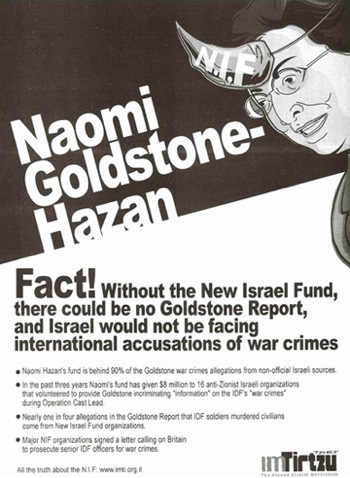
The largest financial supporter of human rights groups in Israel, the New Israel fund, has been targeted by the Israeli right as being responsible for a majority of the critical information gathered in the United Nations' Goldstone Report, which found that Israel had committed war crimes during its 2008 Gaza invasion. Sari Bashi, the executive director of Gisha, is a graduate of the Yale University Law School, and spoke at the school in April about the interconnection of human rights in Israel and Palestine.


SARI BASHI: Both the erosion of human rights for Palestinians and the erosion of democratic protections for Israeli human rights defenders have to do with a crisis of values, a crisis of democratic and universalistic values. We've always said that a democracy --and Israel is a democracy --that is maintaining a military occupation that is obviously non-democratic, cannot maintain these Chinese walls. It's going to spill over in ways that are going to be detrimental. It always has, but now it seems to be more extreme. There's always been a pendulum that's swung back and forth between the government's ability to tolerate dissent and protect the rights of freedom of association and freedom of speech for those who criticize the government. But in the last year, since the Gaza war, it's swung in one direction that I haven't seen before --I've not seen it this bad --and it doesn't show any signs of swinging back any time soon. So I don't know where we are now; we're in some kind of transition.

What am I talking about? The readings talked about this law that would restrict the ability of human rights groups to get funding. That initiative is taking place in the context of a coordinated government campaign against human rights groups in Israel, in the wake of criticism over the Gaza war. There's been a media campaign in which government spokespersons have spread misinformation about human rights groups, characterizing us as a fifth column, calling us a strategic threat, traitors, calling us agents of European anti-Semites, and making it seem as though we're operating secretly, when actually, as human rights groups we believe in transparency and try to act as transparently as possible.

The foreign ministry has created a special unit that is designed to combat Israeli human rights groups, and to some extent also social change organizations. They're doing this in a way that's over-broad, so they're getting some women's groups and environmental groups under their umbrella, probably by mistake, but they're also being harmed by this. They're attempting to obstruct funding from abroad either through legislation making it difficult or impossible, or through political moves, where the Netanyahu government has actually approached different European countries who fund human rights groups through these neighborhood programs that support human rights and said, don't fund these groups that criticize us.

And also the use of the tax law. The law that would restrict foreign funding has tax implications, but even without that being formalized, the tax law is being used to do what I would call harass human rights groups. This summer, the tax authority tried to remove our tax-exempt status because we defend Palestinians. We hired a lawyer who knows more about tax law than I do, and in the meetings that took place between our lawyer and tax officials the level of dialogue was, "Well, they're defending Arabs. That shouldn't be a public goal, so we're taking away their tax-exempt status." There was no allegation of financial wrong-doing. This was purely ideological. I'm glad to say so far we've survived that particular attempt. But it's not just us; other groups have been targeted too.

There've also been arrests of peaceful demonstrators --of Israeli Jews. I'm saying that because the treatment of Israeli Palestinians has always been different --it's always been couched as a security threat. So when Palestinian citizens of Israel were arrested, the government could couch that as a security threat. Now they're arresting Israeli Jews as well, where it's not about a security threat. They say it's an illegal demo. There's no violence, but we're not going to let it take place.

And these are all symptoms of what I would call a crisis of values. Israel is self-defined as a Jewish and democratic state, and that would mean you have particularistic values of protecting the Jewish people, and you have universal values, which are democratic values --international law, human rights that belong to everyone by virtue of being human. And there's always been some kind of uneasy tension and balance. We're now shifting in one particular direction. It creates a challenge for human rights groups, not just in terms of our legal activity but also in terms of our public advocacy. We're fighting for communicability. How do we communicate with the public that is increasingly disagreeing with us not just on political terms, but on ideological terms --what your values are. We're promoting values of universal human rights, of individual rights, of democracy and freedom, and increasingly values that are being promoted in the public sphere and in the political sphere are values of particularistic self-defense; it's us against them; the "them" is dehumanized, and even people who look like us --even Israeli human rights groups --are part of the "them," if they criticize. It's a big question about how we operate. On the one hand there's a crisis. On the other hand, I'm actually a little bit optimistic. Because things have been static for such a long time; we're in a transition, and I don't know what we're transitioning to, but I think there are opportunities here to -- if we can do it right -- to wake people up inside Israel, to say, "Look, you and I may not agree about what the policy should be in the occupied territory, but maybe you're also worried that I'm getting arrested or my freedom of speech is being undermined." And maybe you can understand that there's a price to these particularistic values, about something you care about, because maybe you care about Israeli democracy. And maybe we can get that conversation to expand to human rights.

For more information, visit Gisha's website at www.gisha.org This segment was recorded and produced by Between The Lines' Melinda Tuhus.

Related links: -------------------------------------------------------------------------------
Melinda Tuhus is a executive producer of Between The Lines, which can be heard on more than 45 radio stations and in RealAudio and MP3 on our website at http://www.btlonline.org. This interview excerpt was featured on the award-winning, syndicated weekly radio newsmagazine, Between The Lines for the week ending May 21, 2010. This Between The Lines Q&A was compiled by Melinda Tuhus and Anna Manzo.

To donate to Between The Lines, please send your check made payable to "The Global Center" and mail to:
Squeaky Wheel Productions
P.O. Box 110176
Trumbull, CT 06611

To get details on subscribing to the radio program or to publish this column in print or online media, contact us at (203) 268-8446.

Home | Broadcast-Quality MP3s | Archives | Search BTL Archives
About | Broadcast Schedule | | Squeaky Wheel Productions

(c) Copyright 2010 Squeaky Wheel Productions. All rights reserved.