

Award-winning Investigative Journalist Robert Parry (1949-2018)
Award-winning investigative journalist and founder/editor of ConsortiumNews.com, Robert Parry has passed away. His ground-breaking work uncovering Reagan-era dirty wars in Central America and many other illegal and immoral policies conducted by successive administrations and U.S. intelligence agencies, stands as an inspiration to all in journalists working in the public interest.
Robert had been a regular guest on our Between The Lines and Counterpoint radio shows -- and many other progressive outlets across the U.S. over four decades.
His penetrating analysis of U.S. foreign policy and international conflicts will be sorely missed, and not easily replaced. His son Nat Parry writes a tribute to his father: Robert Parry’s Legacy and the Future of Consortiumnews.
Thank you for donating
If you've made a donation and wish to receive thank you gifts for your donation, be sure to send us your mailing address via our Contact form.
See our thank you gifts for your donation.
The Resistance Starts Now!
Between The Lines' coverage and resource compilation of the Resistance Movement
- "The man who predicted Trump presidential win now says Trump impeachment could happen," AM Joy with Joy Reid, MSNBC, Jan. 21, 2018
- "Sketchy Kazakh money finds its way into Trump dealings," The Rachel Maddow Show, MSNBC, Jan. 15, 2018
- "Red flags seen in many Trump real estate deals," The Rachel Maddow Show, MSNBC, Jan. 15, 2018
- "Secret Money: How Trump Made Millions Selling Condos To Unknown Buyers," BuzzFeed, Jan. 12, 2018
- "The Scandals of Donald Trump: Presidential Edition," The Atlantic, May 15, 2017
- "Here's what we know so far about Team Trump's ties to Russian interests," Washington Post's ongoing compilation
- "What Comey Was Investigating, Explained," The Moscow Project, Center for American Progress
- "Donald Trump's Financial Ties to Russian Oligarchs and Mobsters Detailed In Explosive New Documentary from the Netherlands," Dutch TV documentary, Alternet.org, May 12, 2017
- Ongoing compilation of Trump's creeping authoritarianism," MotherJones.com
- Full resource list ...
SPECIAL REPORT: "The Resistance - Women's March 2018 - Hartford, Connecticut" Jan. 20, 2018
Selected speeches from the Women's March in Hartford, Connecticut 2018, recorded and produced by Scott Harris

SPECIAL REPORT: "No Fracking Waste in CT!" Jan. 14, 2018
- Jen Siskind Jennifer Siskind, local coordinator for Food and Water Watch, describes the campaign to stop fracking waste in Connecticut, which so far has led to fracking waste bans in 34 towns around the state.
Interviewed by Richard Hill on Mic Check, WPKN Radio, Bridgeport, CT
SPECIAL REPORT: "Resistance Round Table: The Unraveling Continues..." Jan. 13, 2018
- Lindsay Kanaly
The panel discusses Trump's long history of racism and the Republican voter suppression juggernaut confronting Democrats leading up to the 2018 elections. Special guest: Lindsay Kanaly, a lead organizer of the Women's Marches planned for Jan. 20, 2018. Panel: Scott Harris, Ruthanne Baumgartner and Richard Hill on Resistance Roundtable, WPKN Radio, Bridgeport, CT.

SPECIAL REPORT: "Capitalism to the ash heap?" Richard Wolff, Jan. 2, 2018
- Richard Wolff,
Economics professor Richard Wolff declares U.S. capitalism to be beyond repair and
suggests the need for a radical alternative. Interviewed by Richard Hill

SPECIAL REPORT: Maryn McKenna, author of "Big Chicken", Dec. 7, 2017
- Maryn McKenna, investigative journalist and author of Big Chicken, talks about the widespread use and dangers of antibiotics in commercial poultry, beef and fruit production. Interview by Bill Duesing, Richard Hill and Guy Beardsly on WPKN's Organic Farm Stand.

SPECIAL REPORT: Nina Turner's address, Working Families Party Awards Banquet, Dec. 14, 2017
- Nina Turner, president of Our Revolution, talks about the fight ahead for progressives as she receives the Working Families Organization Award for Exceptional Leadership Towards Advancing Progress. The event was held in Meriden, CT.
Produced by Richard Hill.
SPECIAL REPORT: Mic Check, Dec. 12, 2017
- Working Families Party of CT talks strategy and issues for 2018.
Lindsay Farrell, executive director of the Working Families Party of Connecticut, discusses the state's electoral landscape and lays out the issues and strategies that could lead to progressive victories in 2018. Interviewed by Richard Hill.
SPECIAL REPORT: Resistance Roundtable, Dec. 9, 2017
- Disturbing developments in the Trump/Republican Agenda
Focus on the tax bill, destruction of our public lands, North Korea and Trump's private CIA. Panel: Scott Harris, Ruthanne Baumgartner and Richard Hill. Special guest: Jo Macallero of Rise and Resist.

SPECIAL REPORT: On Tyranny - one year later, Nov. 28, 2017
- Professor Timothy Snyder, author of the highly acclaimed resistance manual On Tyranny, discusses his book and offers a fresh assessment of the state of our beleaguered republic. Timothy Snyder, history professor at Yale, is introduced by Stanley Heller, administrator of Promoting Enduring Peace, a Connecticut-based organization that sponsored this event at the United Church Parish House in New Haven on Nov. 28. A brief interview with Snyder conducted by WPKN radio producer, Richard Hill, follows his talk.
SPECIAL REPORT: Mic Check, Nov. 12, 2017
- Lynne Ide, director of program and policy with the Universal Health Care Foundation of Connecticut, talks about the current state of health care coverage in Connecticut. Interviewed by Richard Hill, WPKN radio producer
SPECIAL REPORT: Resistance Roundtable, Nov. 11, 2017
- Focus on the Republican tax plan, the just-released autopsy on the Democratic Party, and Internet censorship by Google, Facebook and Youtube. Including an interview with Hilary Grant, a lead organizer with Action Together Connecticut, who discusses the local results of the recent election, with hosts Richard Hill, Scott Harris and Ruth Baumgartner WPKN producers
SPECIAL REPORT: Rainy Day Radio, Nov. 7, 2017
- Two leaders from Redneck Revolt, an anti-racist, anti-capitalist movement, talk about their work organizing with white working class people in Suffolk County, New York. Interviewed by Richard Hill, WPKN radio producer
SPECIAL REPORT: Rainy Day Radio, Nov. 7, 2017
- Bruce Gagnon, coordinator for the Global Network Against Weapons and Nuclear Power in Space, describes the extent of -- and motives underlying -- the vast US network of military bases around the globe. Interviewed by Richard Hill, WPKN radio producer

SPECIAL REPORT: Resisting U.S. JeJu Island military base in South Korea, Oct. 24, 2017
- Joyakol, South Korean peace activist and singer, discusses the crisis on the Korean peninsula and focuses on the resistance to the U.S. huge military base being constructed on Jeju Island. The event was sponsored by the Greater New Haven Peace Council and this audio was recorded by Richard Hill, WPKN producer.
- Joyakol discusses Americans' biggest misconceptions about the conflict between North and South Korea and the U.S., Interview by Richard Hill, WPKN producer.

SPECIAL REPORT: John Allen, Out in New Haven
- John Allen, founding director of the New Haven Pride Center, Connecticut, talks about his new LGBTQ television show, Out in New Haven, which presents a range of political and cultural issues to the community. Interviewed by Richard Hill on WPKN's Rainy Day Tuesday, Jan. 2, 2018.
2017 Gandhi Peace Awards

Promoting Enduring Peace presented its Gandhi Peace Award jointly to renowned consumer advocate Ralph Nader and BDS founder Omar Barghouti on April 23, 2017.
Subscribe to our Weekly Summary & receive our FREE Resist Trump window cling
 (Car window cling)
Email us with your mailing address at contact@btlonline.org to receive our "Resist Trump/Resist Hate" car window cling!
THANK YOU TO EVERYONE...
who helped make our 25th anniversary with Jeremy Scahill a success!
For those who missed the event, or were there and really wanted to fully absorb its import, here it is in video
Jeremy Scahill keynote speech, part 1 from PROUDEYEMEDIA on Vimeo.
Jeremy Scahill keynote speech, part 2 from PROUDEYEMEDIA on Vimeo.
Between The Lines on Stitcher

Between The Lines Presentation at the Left Forum 2016

"How Do We Build A Mass Movement to Reverse Runaway Inequality?" with Les Leopold, author of "Runaway Inequality: An Activist's Guide to Economic Justice,"May 22, 2016, John Jay College of Criminal Justice, The City University of New York, 860 11th Ave. (Between 58th and 59th), New York City. Between The Lines' Scott Harris and Richard Hill moderated this workshop. Listen to the audio/slideshows and more from this workshop.
Listen to audio of the plenary sessions from the weekend.
JEREMY SCAHILL: Oscar-nominated documentary filmmaker "Dirty Wars"
Listen to the full interview (30:33) with Jeremy Scahill, an award-winning investigative journalist with the Nation Magazine, correspondent for Democracy Now! and author of the bestselling book, "Blackwater: The Rise of the World's Most Powerful Mercenary Army," about America's outsourcing of its military. In an exclusive interview with Counterpoint's Scott Harris on Sept. 16, 2013, Scahill talks about his latest book, "Dirty Wars, The World is a Battlefield," also made into a documentary film under the same title, and was nominated Dec. 5, 2013 for an Academy Award in the Best Documentary Feature category.
Listen to Scott Harris Live on WPKN Radio
Between The Lines' Executive Producer Scott Harris hosts a live,
weekly talk show,
Counterpoint, from which some of Between The Lines'
interviews are excerpted. Listen every Monday evening from 8 to 10 p.m.
EDT at www.WPKN.org
(Follows the 5-7 minute White Rose Calendar.)
Counterpoint in its entirety is archived after midnight ET
Monday nights,
and is available for at least a year following broadcast in
WPKN Radio's Archives.
You can also listen to
full unedited interview segments from Counterpoint, which
are generally available some time the day following broadcast.
Subscribe to Counterpoint bulletins via our subscriptions page.
 BTL Blog
[an error occurred while processing this directive]
 Special Programming
[an error occurred while processing this directive]
Progressive Resources
A compilation of activist and news sites with a progressive point of view
 Subscribe to BTL
Podcasts: direct or via iTunes
Subscribe to Program Summaries, Interview Transcripts or Counterpoint via email or RSS feed
If you have other questions regarding subscriptions, feeds or podcasts/mp3s go to our Audio Help page.
Stay connected to BTL


Learn how to support our efforts!
Sister of 9/11 Victim Urges Nonviolent Response to Boston Marathon Bombing
 RealAudio
Posted April 24, 2013
Interview with Terry Kay Rockefeller, documentary film producer and sister of 9/11 victim, conducted by Scott Harris
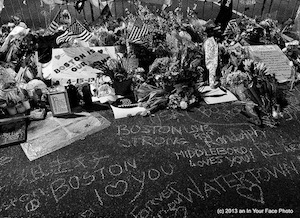
The violence and fear that gripped Boston with the bombing of the city’s annual marathon and the subsequent manhunt that tracked down the two suspects in the case, has given way to a familiar national debate on terrorism and its causes. One of the suspects, Tamerlan Tsarnaev was killed in a shootout with police on April 18, while his younger brother Dzhokhar Tsarnaev was captured hiding in a boat in the Boston suburb of Watertown. Investigators who have questioned Dzhokhar in his hospital bed say a picture is emerging of the bomb plot planned by the older brother, recently steeped in radical Islam, without foreign links or assistance.
Predictably, some conservative politicians called for the bombing suspect to be designated as an enemy combatant while others like Rep. Peter King, R-N.Y., called for "increased surveillance" of the Muslim community, declaring, “We can’t be bound by political correctness.” The Obama Justice Department has charged 19-year-old Dzhokhar Tsarnaev with using a weapon of mass destruction in the bomb explosion that killed three and wounded at least 176 last week – and will try him in U.S. federal court.
Between The Lines' Scott Harris spoke with Boston resident Terry Kay Rockefeller, a documentary film producer who joined the group September Eleventh Families for Peaceful Tomorrows soon after her sister, Laura, was killed in the 9/11 terrorist attack on the World Trade Center. Here, she discusses her response to the recent marathon bombing in Boston and the difficult work of turning grief into action for peace and breaking the cycles of violence engendered by war and terrorism.
TERRY KAY ROCKEFELLER: When I first learned about the bombing, I just was heartbroken. I think as events evolved over the course of the week, it's been really, truly something that perhaps has never happened in history before. I mean, the evidence of the alleged perpetrators was produced terribly quickly, and the of course, we had the experience of waking up on (Friday) morning to find out there had been a violent car chase and shooting, and one of the suspects was dead, that the other one was still on the loose, and the notion to "shelter in place" - it was a new phrase.
But, I have to say, your know, I'm tremendously grateful for intelligent and swift police action. I'm also very grateful that the remaining suspect, who was captured after the daylong "sheltering in place," you know, is now going to be charged in federal court, and that there will be a trial that is not trying him as a foreign terrorist or "enemy combatant."
In some ways, things have happened so quickly in response to the marathon bombings where we don't have a proper legal response to the 9/11 attacks, which is a frustration on my part.
BETWEEN THE LINES: The group you're involved in, September Eleventh Families for Peaceful Tomorrows' mission is to promote a nonviolent response to terrorism. It's an incredibly difficult task with so much fear and hate engendered by terrorist attacks and violence. I'm wondering, as you look at this bombing incident in Boston, how do you hope the response is different than what we all experienced - as a nation and pretty much the world - after the 9/11 attacks? Of course, the scale is different, but we've hopefully learned some things since 9/11. What do you hope for?
TERRY KAY ROCKEFELLER: Well, let me start by saying that I am not an expert on all the options we have. But I do have some very heartfelt hopes. As the evidence unfolded about who the suspects in the bombing at the marathon are, and as we are learning more and more about the role that radical Islam may have played in these two brothers' motivations – and let me also say that I truly believe people are innocent until found guilty – but because of 9/11 and because of the history that we've lived through since 9/11, I think we need as individuals, as a nation, and as a world community to really try to understand how we can have, how we can establish a dialogue with radical Islam. I mean, I can't you Scott, that I have thought about, "Well, tomorow I'd like to do this," or "In six months, we should create this kind of institution. But I truly believe that radical Islam and that Muslims who carry out terrorist acts are not expressing the truth and the wisdom of their religion. On the other hand, I believe they are people who have an agenda, just as one had to establish a dialogue the the terrorists in Northern Ireland. The ways in which you break these cycles of violence is by actually inviting people to participate in some communal discussion, diplomacy, political systems and I hope this makes us think very hard about how to do that.
BETWEEN THE LINES: Terry, I'm curious about your response to the discussion we've had in our media since the Boston marathon bombings, including a comment by New York state Peter King, who recently said, "It's time to stop being so politically correct and recognize the real threat to the United States comes from Islamic terrorism," which means law enforcement must put a heightened focus on Muslim communities. He favors profiling Muslims in general, the entire community, for surveillance. How do you respond to these predictable and certainly historic, at this point, reactions to terrorist attacks?
TERRY KAY ROCKEFELLER: Well, first of all, I respectfully disagree with Peter King. I don't believe that you categorically label everyone who's a color or a religion or a gender or profiling is not the issue. And I think that that kind of response is exactly the way in which you heighten the resentment of people who are likely to become terrorists. I believe that in the long run, the security of not only Americans, but the security of people around the world, will be enhanced if we follow the rule of law. So, I try to motivate people to think of those issues. I try to speak out for that wherever I can. I try to motivate people to think about those issues.
Terry Kay Rockefeller is a member of the group September Eleventh Families for Peaceful Tomorrows. Find more information on organizations advocating non-violent responses to terrorism by visiting peacefultomorrows.org/.
Related Links:
-
 Interview conducted by Scott Harris, Counterpoint, April 22, 2013 (26:31)
- "GOP lawmaker calls for 'increased surveillance' of Muslims after attack," The Hill, April 19, 2013
- "Lindsey Graham: Boston Suspect's 'Ties To Radical Islamic Thought' Justifies 'Enemy Combatant' Status," Huffington Post, April 24, 2013
- "What rights should Dzhokhar Tsarnaev get and why does it matter?" The Guardian, April 20, 2013
- "The Constitution Applies to All Americans, No Matter What They Are Accused Of," Common Dreams, April 22, 2013
- The Iraqi Civil Society Solidarity Initiative at iraqicivilsociety.org
Home | History | Staff | Broadcast-Quality MP3s | Station Information | Audio Archives | Audio Help | Transcripts |
© Squeaky Wheel Productions 2017 | Design: no left turn | Site Architecture: